
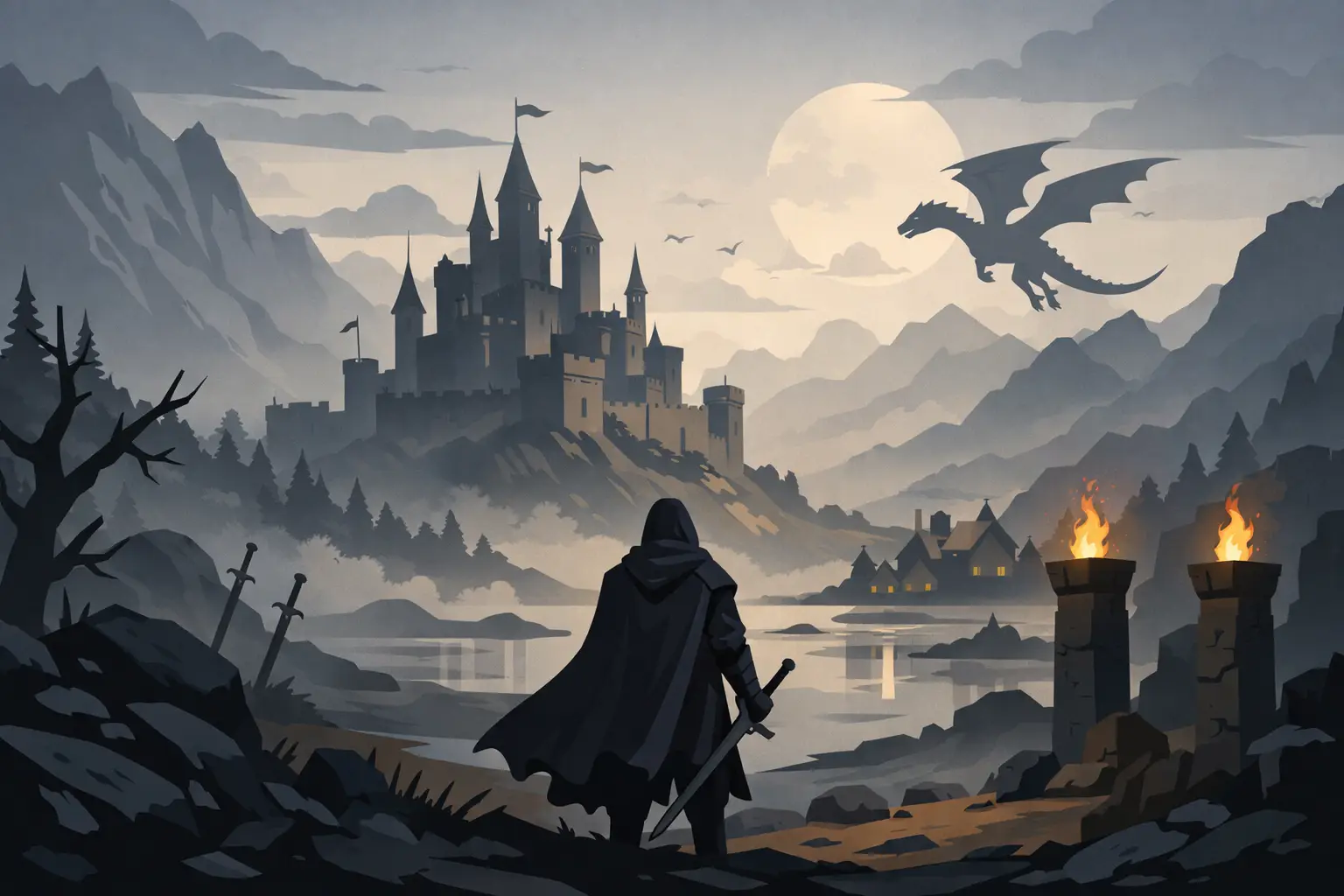
A crowned king kneels before a relic he does not believe in, because his army does. A monastery keeps records of miracles and executions in the same hand. A city wall holds not only against invaders, but against famine, plague, heresy, and memory. This is the native ground of medieval inspired dark fantasy – not merely a world of swords and stone, but a world where belief itself can condemn, consecrate, or break a realm.
Readers return to this strain of fantasy for more than armor, banners, and ruined keeps. They come for pressure. In a truly convincing dark fantasy shaped by the medieval imagination, power is never abstract. It is inherited, contested, sanctified, and stained. Every oath carries a cost. Every throne stands on older bones. The setting does not serve as decoration. It acts as judgment.
What medieval inspired dark fantasy really means
The phrase is often used too loosely. Any grim story with castles is not enough. Medieval inspired dark fantasy draws its strength from a deeper inheritance: feudal hierarchy, sacred authority, dynastic fragility, brutal law, and the constant nearness of death. These elements create a moral climate that feels older and harder than modern fantasy dressed in period clothing.
The medieval world was structured by obligation. A ruler answered to bloodline, church, land, and war. A peasant’s life could be bent by weather as much as by politics. A knight’s glory was inseparable from violence. When dark fantasy uses this framework well, it does not just imitate the look of the period. It understands that institutions were intimate and merciless. Faith was not a private preference. It was public power.
That is why the best works in this mode feel dense even before the plot fully unfolds. You can sense unseen pressures in the background – old schisms, disputed succession, sacred law, famine years, border raids, relic cults, failed crusades, broken treaties. The world feels inhabited by history, and history in these settings is rarely at peace.
Why the medieval frame makes darkness feel earned
Darkness in fantasy can become hollow when it exists only to shock. Endless cruelty, casual betrayal, and ash-colored scenery do not automatically create seriousness. Medieval inspired dark fantasy works when the darkness grows from structure rather than spectacle.
If a kingdom is bound together by divine legitimacy, then a crisis of faith is also a political crisis. If land and title determine survival, then inheritance disputes become engines of war. If salvation depends on institutions corrupted by ambition, then piety becomes dangerous. The setting gives shape to suffering. Violence does not appear from nowhere. It emerges from a believable order of life.
This is also why moral conflict carries more weight here than in cleaner heroic fantasy. A lord may commit atrocity to preserve stability. A priest may defend doctrine because without it, the realm fractures. A rebel may speak the truth and still deliver a country to ruin. In such stories, guilt is rarely isolated to villains. It spreads through systems, families, and beliefs.
That shared stain is part of the appeal. Readers are not simply watching characters make bad choices. They are watching people move within a world that punishes purity and tests conviction.
Faith, power, and the soul of the genre
One of the clearest markers of medieval inspired dark fantasy is the seriousness with which it treats religion. In lesser fantasy, faith exists as flavor – temples in the background, a few named gods, perhaps a holy order in polished armor. In stronger work, religion shapes law, warfare, kingship, burial, marriage, literacy, and rebellion.
This changes everything.
When faith is foundational, belief becomes inseparable from legitimacy. A ruler crowned without sacred sanction may hold the capital and still seem false. A prophet may threaten the realm more than any general. A heresy can function as a social revolution. Even private doubt becomes dangerous, because doubt in such worlds is never merely internal. It can alter obedience, fracture alliances, and reopen old wounds.
Dark fantasy thrives in this terrain because religion introduces a terrible ambiguity. Is the miracle real, or politically useful? Is the martyr holy, or reckless? Is the god absent, sleeping, or demanding blood? Medieval settings allow these questions to feel unavoidable. They belong to the architecture of the world.
For readers who want fantasy with theological gravity, this is where the genre becomes unforgettable. The conflict is not only who will rule, but what makes rule just. Not only who is damned, but who has the authority to name damnation.
The role of history in medieval inspired dark fantasy
The finest settings in this tradition feel older than the protagonists. That may sound obvious, but many fantasy worlds present history as a shelf of interesting facts. Medieval inspired dark fantasy makes history active. It intrudes.
A century-old betrayal still decides who can marry whom. A dead saint still commands armies through relic and myth. A conquered province still speaks with resentment. A civil war still lives in prayer books and ruined fortresses. The past is not complete. It remains sovereign over the present.
This matters because dark fantasy depends on consequence. If the world resets after every battle, then tragedy loses force. But when institutions remember, when houses keep grudges, when scripture preserves old violence in sacred language, every new conflict feels tethered to something larger.
That is one reason readers with a taste for immersive worldbuilding often gravitate here. The pleasure is not only in immediate drama. It is in sensing layers beneath it. A realm becomes convincing when it can wound its own people through memory.
Where many stories get it wrong
There is, however, a difference between severity and depth. Some books mistake bleakness for maturity. They load the page with mud, cruelty, assault, corruption, and hopeless rulers, assuming this alone creates a dark medieval atmosphere. It does not.
Without moral architecture, darkness loses meaning. If every institution is equally rotten, every character equally cynical, and every act equally doomed, then the world flattens. Readers stop feeling tragedy because there is no lost ideal to mourn.
The medieval imagination, even at its harshest, was not empty of transcendence. It was full of judgment, ritual, cosmic order, sacred terror, and the possibility – however distant – of redemption. Dark fantasy needs some remnant of this vertical dimension. Otherwise it becomes merely grim.
This is the trade-off at the heart of the genre. Too much idealism, and the darkness softens into conventional epic fantasy. Too much nihilism, and the story loses spiritual and emotional tension. The strongest works stand between those extremes. They let grace exist, but at a cost. They allow honor, but under siege. They make hope difficult enough to matter.
Why readers still hunger for these worlds
Part of the answer is aesthetic. Stone citadels, reliquaries, winter roads, torchlit courts, monastic libraries, rusted crowns – these images still carry force. But atmosphere alone does not explain the genre’s endurance.
Readers return because medieval inspired dark fantasy gives form to fears that remain modern. Who deserves power? Can institutions founded on faith survive corruption? What happens when law serves order but not justice? How much blood can a realm absorb before its sacred stories stop holding it together?
These are old questions, yet they do not feel distant. The medieval frame sharpens them by stripping away modern insulation. There are no bureaucratic comforts, no stable secular assumptions, no easy separation between personal conscience and public life. Belief and authority stand closer to the bone.
That closeness is what gives the genre its force. It offers not escapism in the light sense, but immersion into a harsher grammar of existence. The world feels perilous, yes, but also morally legible in a way our own age often does not. Sin, duty, oath, treason, sacrifice – these terms have weight there.
For many readers, that weight is precisely the attraction. A world forged in hierarchy, prophecy, rebellion, and sacred violence can reveal human motive with unusual clarity. Naissusbooks understands this instinct well: that fantasy grows more compelling when the realm is not only vast, but burdened by faith, history, and the terrible intimacy of power.
What makes the subgenre worth reading now
Medieval inspired dark fantasy endures because it treats civilization as fragile and costly. It remembers that kingdoms are maintained through hunger, prayer, fear, law, inheritance, and force. It asks whether holiness can survive ambition, whether legitimacy can survive truth, and whether mercy can survive war.
Those are not small questions. They are the kind that stay with a reader after the final page, when the banners have fallen still and the victor looks too much like the defeated.
Read this subgenre, then, not for darkness alone, but for the severe light it casts on power. In these worlds, every crown is a burden passed from wounded hands, and every oath asks what a soul is worth when a realm begins to burn.