
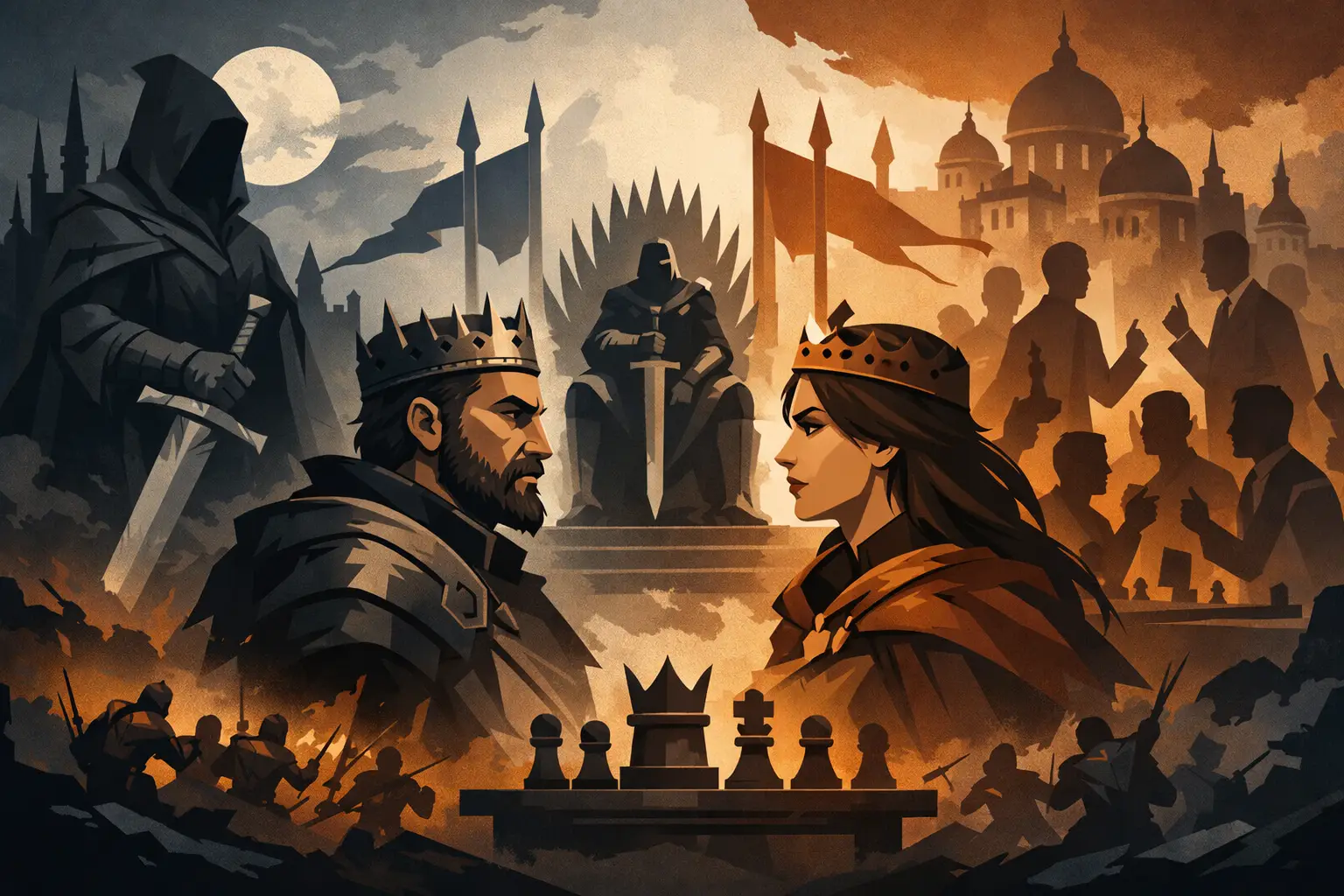
A kingdom does not fall because one villain twirls a knife in the dark. It falls because vows rot, priests bless ambition, councils mistake caution for wisdom, and men who call themselves saviors decide who must be sacrificed. That is the true force of grimdark fantasy with politics. It does not merely ask who will win the throne. It asks what the throne has already cost, and what kind of soul still dares to claim it.
For readers who hunger for more than battlefield spectacle, this is where fantasy becomes piercing. Steel still matters. Sorcery still terrifies. But power is no longer a prize at the end of the road. Power is the road itself – paved with compromise, sanctified by doctrine, and guarded by those who profit from disorder.
What makes grimdark fantasy with politics different?
Plenty of fantasy includes kings, wars, and succession disputes. That alone does not make it political in a meaningful sense. In grimdark fiction, politics is not background architecture. It is a predatory system that shapes every private grief and public catastrophe.
The distinction matters. In lighter epic fantasy, the ruler may be corrupt, but corruption is often localized. Remove the tyrant, restore the rightful heir, and order can return. Grimdark rarely grants that comfort. The rot goes deeper. Institutions preserve themselves. Noble houses speak of honor while counting debts in blood. Religious orders promise salvation while tightening their hold over law, memory, and fear.
This is why the genre feels heavier. The conflict is not simply between good people and wicked people. It is between competing claims to legitimacy, each stained in advance. A rebellion may begin with justice and end in massacre. A usurper may be cruel yet competent. A holy cause may defend the weak while feeding on persecution. Politics in grimdark fantasy does not clarify morality. It puts morality under siege.
Why political struggle sharpens the darkness
Grimdark lives by consequence. Political struggle gives those consequences reach.
When a betrayal happens in a small, personal story, the damage may remain intimate. When betrayal happens in a court, a church, or a military command, the wound spreads outward. Famine follows policy. Purges follow doctrine. Border wars begin with a whispered alliance made in candlelight. In this kind of fantasy, one decision at the top can condemn thousands who will never know the names of those who sentenced them.
That scale is part of the appeal. The darkness feels earned because it is structural, not decorative. Misery is not there to make the setting look mature. It emerges from systems built to reward force, secrecy, and ruthless timing.
The best examples understand restraint. If every chapter insists that everything is hopeless, the effect dulls. What gives grimdark political fantasy its edge is contrast – a fragile oath, an honest magistrate, a commander who refuses one atrocity too many. Small acts of conscience matter more when the order around them is hostile to mercy.
Crowns, creeds, and councils
Political grimdark becomes especially potent when power is divided among rival authorities.
A crown claims legal rule. A temple claims divine sanction. A noble council claims inherited right. A military order claims necessity. None of them are neutral. None of them are merely symbolic. Each has its own language of righteousness, and each can make a persuasive case for why its violence is regrettable but required.
This is where the genre becomes truly rich. Readers are not just watching armies collide. They are watching worldviews collide. A coronation can be a theological event. A marriage treaty can be a declaration of war. A heresy trial can decide the fate of provinces. Politics stops being administration and becomes metaphysical conflict embodied in law, ritual, and bloodline.
For a brand like Naissusbooks, where faith, legitimacy, rebellion, and burdened rule sit at the heart of the world, this territory feels especially alive. Grim fantasy with politics thrives when belief is not window dressing but a governing force. A kingdom is easier to understand than a kingdom that believes it was chosen. A tyrant is easier to resist than a tyrant believed to be sacred.
The characters who make it work
A political setting alone is not enough. Grimdark rises or falls on the people trapped inside the machinery.
The most compelling figures in this space are rarely pure schemers or pure victims. They are rulers who inherit broken realms, priests who fear the truths they defend, heirs who know their claim is lawful but not just, and rebels who discover that victory demands becoming legible to the same brutal logic they once opposed.
That tension gives the genre its charge. Readers do not want spotless champions wandering through filth untouched by it. They want characters who are changed by pressure, who make hard calculations for reasons that feel human, and who understand that survival can become its own form of corruption.
There is, however, a line between complexity and emptiness. If every character is cynical in the same way, the story flattens. The strongest grimdark political fiction preserves difference. One person compromises out of fear, another out of devotion, another out of hunger, another because they genuinely believe order is worth cruelty. Motive creates texture. Without it, darkness becomes costume.
Why readers keep returning to grimdark fantasy with politics
Part of the answer is simple. It feels closer to history than cleaner fantasy does.
Not because it is more realistic in a literal sense. Dragons and prophets can exist beside impossible geography and invented gods. What feels true is the pressure of power. Thrones attract opportunists. Institutions rewrite their own sins. Noble language conceals ordinary greed. People do terrible things while insisting they are preserving civilization.
Readers who love this subgenre often want that severity. They want fantasy that respects the intelligence of its audience, that understands empires are not maintained by charisma alone, and that treats governance as something more dangerous than a scenic backdrop. The reward is a world that feels inhabited rather than staged.
There is also a deeper satisfaction at work. Political grimdark allows for tragedies that feel inevitable without feeling cheap. When the reader can trace a disaster through law, custom, theology, old grievance, and private ambition, the fall lands harder. It was preventable, perhaps, but never easy to prevent. That is a more haunting kind of sorrow.
The trade-offs of the subgenre
This kind of fantasy is not for every mood, and its excesses are real.
Some books confuse density with depth. They pile on factions, titles, and betrayals until human feeling disappears beneath the record of events. Others mistake nihilism for seriousness, as though despair alone can substitute for insight. A brutal world must still reveal something worth seeing, whether that is conviction under siege, the seduction of authority, or the cost of false salvation.
Pacing can also become a challenge. Political stories require setup, and grimdark demands consequence. If the story lingers too long in explanation, it loses heat. If it rushes the machinery of power, it loses credibility. The balance is delicate. The best authors make politics feel immediate because every decree and alliance reaches into a character’s body, faith, inheritance, or shame.
For readers new to the style, it helps to know what they want most. If you care primarily about tactical intrigue, you may prefer a colder, court-centered narrative. If you want theology and dread woven into statecraft, look for stories where religion shapes law and legitimacy. If what compels you is moral collapse under pressure, choose books anchored in a few central perspectives rather than sprawling councils alone. It depends less on how dark a story is and more on what kind of darkness it understands.
What the best political grimdark leaves behind
When it works, this subgenre lingers for a particular reason. Not because it shocked you. Not because it killed someone beloved. Those are the easier tricks.
It lingers because it makes power feel intimate. It shows that kingdoms are built from private vows, inherited myths, and sanctioned cruelties. It reminds us that people do not step into corruption as though crossing a clear threshold. They justify, adapt, obey, and endure until the monstrous begins to resemble order.
Yet even here, the genre is not empty of light. Its light is simply costly. A refusal. A confession. A mercy offered too late to save a realm, but not too late to save a soul. In worlds governed by force and fear, such acts carry the weight of revelation.
That is why grimdark fantasy with politics matters. It restores danger to power and consequence to belief. It gives us realms where crowns are heavy, faith is contested, and every banner raised in hope may cast a longer shadow than anyone intended.
Read it, then, not to be comforted, but to be confronted. The finest dark fantasy does not merely show a broken kingdom. It asks what kind of truth can still survive inside one.