
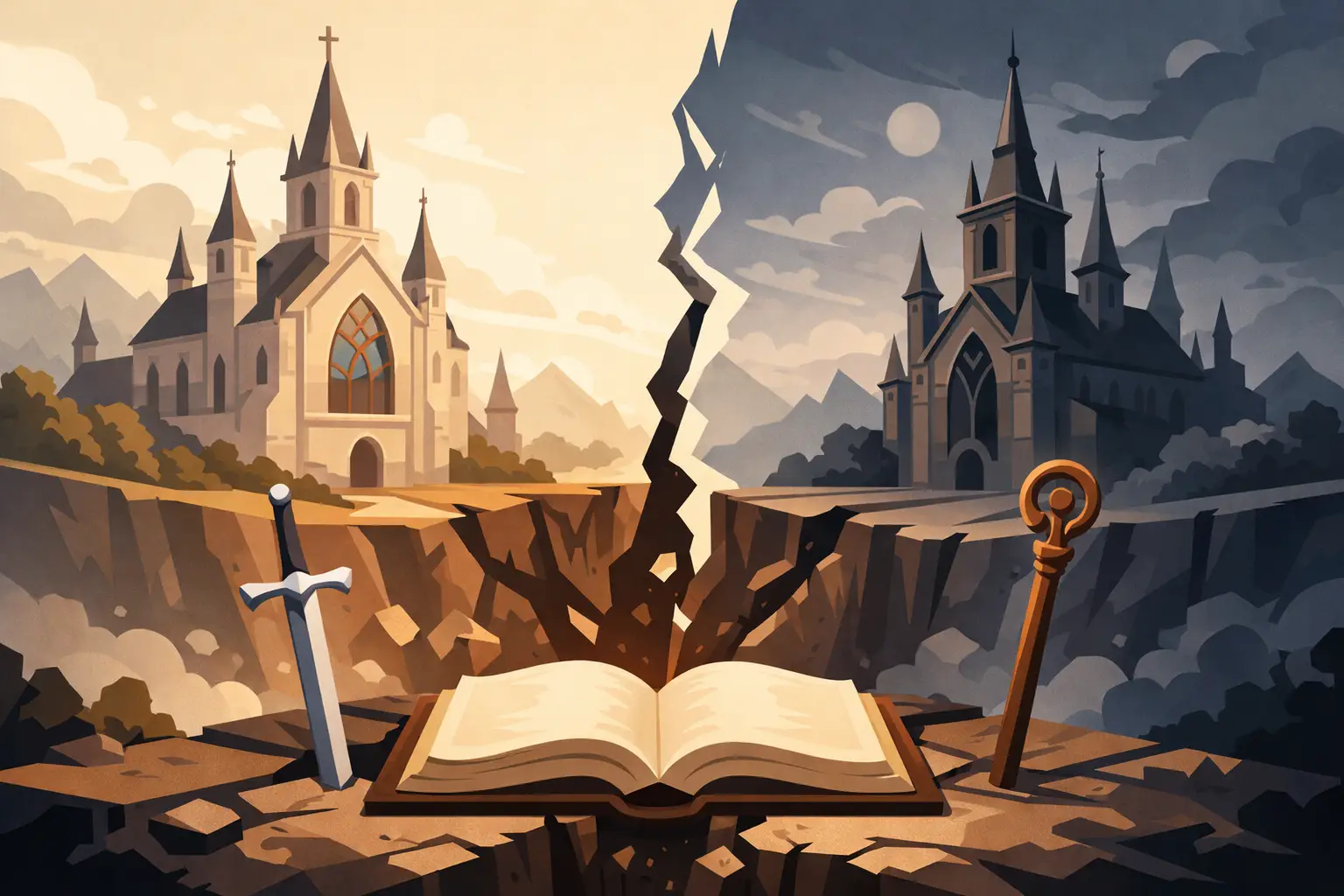
Some fantasy wars begin with a crown. The most haunting ones begin at the altar. The best fantasy books about church schism do not use religion as painted scenery or a convenient villain. They treat belief as a force that crowns kings, breaks empires, sanctifies cruelty, and gives the broken a language for hope.
That distinction matters. A church schism in fantasy is never only a doctrinal dispute. It is a struggle over legitimacy, memory, ritual, succession, and the right to define the sacred. When written with gravity, these stories feel larger than palace intrigue because they reach past law and bloodline into conscience itself. They ask a harsher question than who should rule. They ask who has the right to name truth.
Why fantasy books about church schism hit so hard
Political fantasy often turns on armies and councils. Religious fantasy, at its strongest, turns on interpretation. A single fracture in a holy order can split cities, reorder alliances, and turn yesterday’s saint into today’s heretic. That gives this kind of story unusual pressure. Every sermon, relic, rite, and prophecy can become a battlefield.
It also gives the genre moral depth. Schism narratives rarely offer clean sides. One faction may defend orthodoxy while hiding corruption. Another may speak for reform while inviting chaos. A visionary may be sincere and still become ruinous. A guardian of tradition may be cruel and still preserve something real. For readers who want fantasy with theological weight, that ambiguity is the point.
The books below are not identical. Some place church fracture at the center of the plot. Others build worlds where competing sects, priesthoods, or sacred institutions shape every political decision. What binds them is the sense that faith is not decorative. It is a living structure of power.
7 fantasy books about church schism worth your time
The Curse of Chalion by Lois McMaster Bujold
This is not the loudest example on the list, but it is one of the most intelligent. Bujold builds a theology that feels inhabited rather than diagrammed, and the conflict between divine order, political legitimacy, and human suffering gives the novel its lasting force. The religious structure is woven into governance, sainthood, miracles, and the burden of service.
What makes it essential for this theme is the way sacred authority and temporal authority cannot be cleanly separated. Questions of succession become questions of divine will. Spiritual fracture is felt less as open civil war and more as a corrosive instability within the body of the realm. If you want theological fantasy with restraint and seriousness, start here.
The Witness for the Dead by Katherine Addison
This novel is quieter than many dark epics, but it understands institutional religion with rare precision. Its protagonist serves as a cleric and witness to the dead, moving through a world where ritual obligation, ecclesiastical hierarchy, and social fracture intersect constantly. The church is not merely symbolic. It is administrative, sacred, political, and human.
The schism element here is less about explosive denominational war and more about the subtle fracture that appears when institutions lose moral coherence. That makes it powerful in a different register. Readers who prefer solemn atmosphere over battlefield spectacle will find much to admire.
The Pariah by Anthony Ryan
Anthony Ryan’s world carries the weight of militant faith, contested sanctity, and weaponized doctrine. The church-like institutions in this series are not abstract centers of piety. They shape military power, social order, and the legitimacy of violence. Heresy is never only theological. It is political, public, and often fatal.
What makes The Pariah especially compelling is its sense that religious division can produce both genuine devotion and calculated manipulation. The result is a story where competing visions of the sacred become engines of rebellion. If your taste runs toward grim atmosphere, bruised idealism, and faith under strain, this belongs on your shelf.
The Tyrant Baru Cormorant by Seth Dickinson
This is one of the sharpest portraits of ideological fracture in modern fantasy, even if it does not map neatly onto a medieval church model. Dickinson writes systems of belief with a cold, devastating clarity. Empire, doctrine, cultural conversion, and resistance are all entangled, and every conflict over truth becomes a conflict over bodies, economies, and futures.
Readers looking specifically for cathedral fantasy may find this a less direct fit than others here. Still, if what you want is the deeper structure of schism – rival orthodoxies, state-backed dogma, reformist vision, and the terrible cost of dissent – Baru delivers it with frightening intelligence.
The Justice of Kings by Richard Swan
Richard Swan’s world is thick with legal and religious authority, and that overlap gives the novel its edge. The empire’s claims to order are backed not only by force but by metaphysical and institutional legitimacy. As the series unfolds, religious fault lines widen, and the old unity of law, crown, and sacred order begins to split.
This is a strong choice for readers who want their church schism bound to imperial decline. Swan understands that when faith fractures, procedure fractures with it. Trials, judgments, and public punishments all begin to feel unstable because the moral center that authorized them is no longer secure.
Priest of Bones by Peter McLean
At first glance, this may look like an underworld fantasy rather than a religious one, but its treatment of church power is too significant to ignore. The sacred institutions in McLean’s world are predatory, political, and deeply embedded in the machinery of fear. Religion here is neither distant nor pure. It is close to the street, close to the blade, and close to the throne.
The schism is not always formalized in councils and decrees. Often it appears as moral decomposition within the institution itself, where official sanctity and practical corruption can no longer pretend to coexist. That gives the book a bleak credibility. It is fantasy for readers who believe the holiest facades often hide the deepest wounds.
The Name of the Rose by Umberto Eco
Not strictly secondary-world fantasy, but too relevant to leave unspoken. Eco’s novel is historical, philosophical, and exacting, yet its atmosphere has shaped generations of dark fantasy that deal with doctrine, heresy, forbidden knowledge, and monastic power. If your interest in fantasy books about church schism comes from a hunger for theological conflict with genuine intellectual substance, this is part of the lineage.
It is denser than the other titles here, and some readers will find it more demanding than immersive. But its central concerns – who interprets truth, who controls knowledge, and how institutions answer fear with persecution – remain foundational for the subgenre.
What separates great church-schism fantasy from shallow religious window dressing
The difference usually lies in consequence. In lesser books, religion exists to give characters titles, costumes, and an excuse for villainy. In stronger books, doctrine shapes law, marriage, inheritance, burial, warfare, and memory. A schism then feels catastrophic because it tears through the daily grammar of the world.
The second difference is sympathy. Not approval, but sympathy. A convincing religious conflict requires the author to understand why people would submit to ritual, defend orthodoxy, fear heresy, or risk death for reform. Once every priest is a hypocrite and every dissenter a modern-minded hero, the drama flattens. True fracture is harder than that. It is built from sincere conviction colliding with ambition, fear, and grief.
This is why the best examples feel so durable. They do not sneer at faith, and they do not sentimentalize it. They understand that sacred institutions can preserve meaning across centuries and still become engines of repression. They understand, too, that rebellion can be morally necessary and spiritually disastrous.
If this is your niche, read for institutions, not just icons
Readers who love this corner of the genre often look first for imagery – cathedrals, relics, choirs, inquisitors, saints. Those things matter. They give texture. But the deeper pleasure comes from institutions under strain. Watch how a book handles succession. Watch who appoints bishops, interprets prophecy, licenses violence, or rewrites canon. That is where schism begins to feel real.
It is also where worldbuilding either stands or collapses. A believable sacred order has rivals, records, ceremonies, regional variations, and political debts. It remembers old councils and old betrayals. It has language for sin, but also language for mercy. When fantasy reaches that level of density, every conflict gains gravity.
For readers drawn to dark, lore-rich fiction shaped by faith, power, and fracture, that gravity is the reward. It is the sense that the world was not assembled for plot alone, but born of belief, burdened by history, and forged in rebellion. Naissusbooks stands in that same shadowed tradition.
If you are hunting for your next read, choose the book that treats schism not as spectacle, but as a wound in the soul of a civilization. Those are the stories that linger after the candles burn low.