
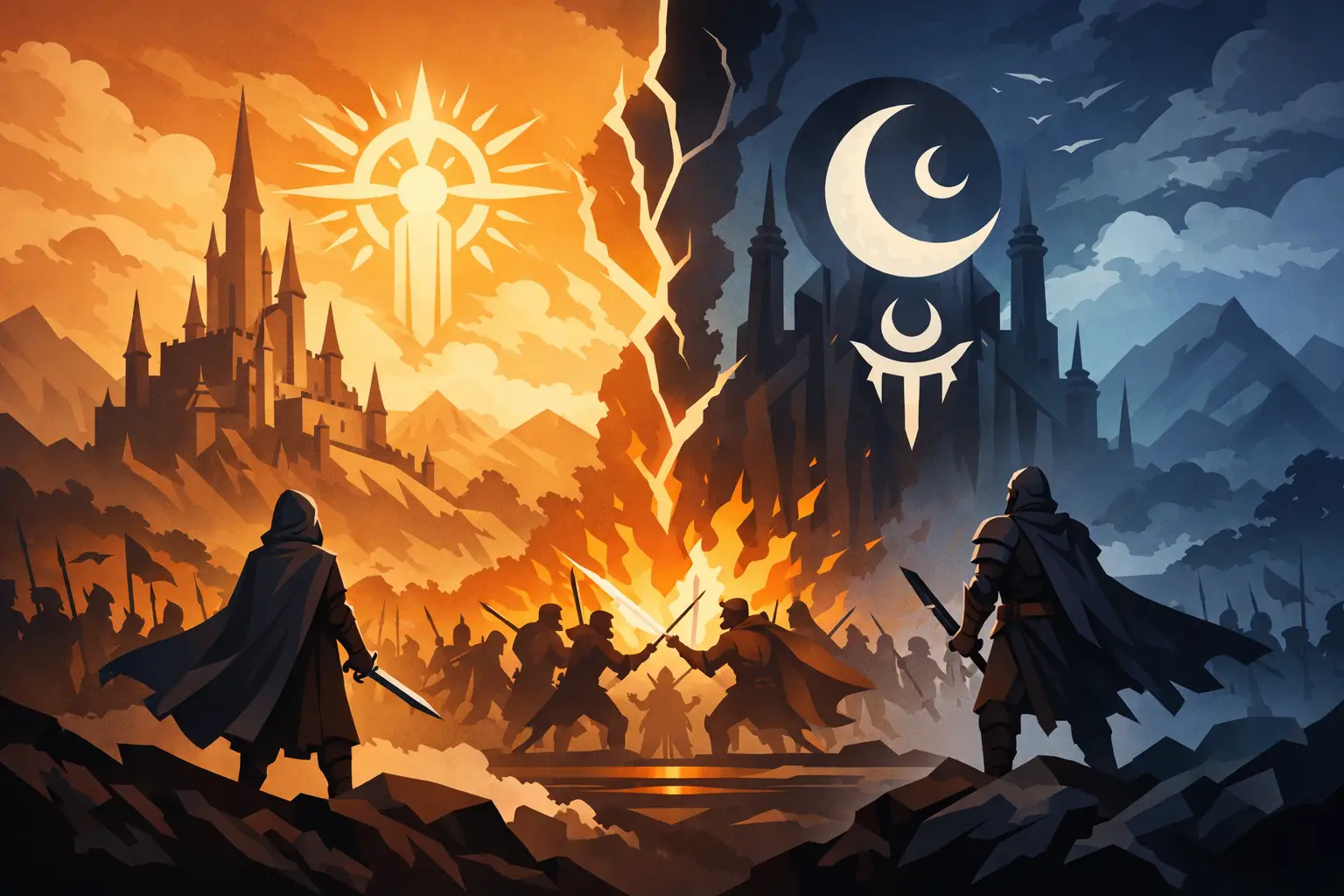
A throne can be stolen in a night. A god cannot. That is why epic fantasy with religious conflict carries a different kind of weight than ordinary tales of succession, conquest, or revenge. When belief stands at the center of a secondary world, every war becomes more than a contest for land. It becomes a struggle over truth, salvation, memory, and the right to name evil.
The best fantasy understands this instinctively. Kingdoms endure famine, invasion, and civil unrest, yet what often breaks them is a wound to the sacred order that once held them together. A disputed prophecy, a corrupt priesthood, a reformer branded a heretic, a monarch who claims divine sanction while ruling through cruelty – these are not decorative elements. They alter law, shape armies, divide bloodlines, and turn private doubt into public catastrophe.
What makes epic fantasy with religious conflict distinct
Religious conflict in fantasy works best when it is not treated as a costume draped over familiar politics. If faith exists only to make the setting feel medieval, it remains shallow. If it governs burial rites, oaths, legitimacy, marriage, kingship, war, and the meaning of sin, then it becomes part of the world’s spine.
That distinction matters. In lesser stories, religion functions as an aesthetic shorthand for fanaticism. In stronger ones, faith is both shelter and weapon. It comforts the dying, binds scattered peoples into one civilization, justifies rebellion, and gives tyrants language grand enough to bless their own violence. The result is moral pressure on every level of the narrative.
A peasant conscript may not fully understand royal policy, but he knows whether he marches under a sanctified banner or an accursed one. A queen may command armies, yet still require the blessing of an order whose authority predates her bloodline. A prophet may possess no army at all and still threaten an empire merely by persuading the faithful that the old covenant has failed.
That is why these stories feel larger than politics alone. Political conflict asks who should rule. Religious conflict asks by what right the world is ordered at all.
Why faith raises the stakes beyond simple good and evil
Many readers come to dark epic fantasy because they want moral complexity rather than neat heroism. Religious conflict intensifies that complexity when it is written with seriousness. Not all believers are righteous. Not all doubters are wise. Not all institutions are rotten from root to branch.
The deepest versions of this theme resist easy contempt. A church may preserve scholarship, feed the poor, and maintain peace across fractured provinces, even while its leadership conceals crimes. A reform movement may speak truth about corruption, yet unleash iconoclasm, civil slaughter, and purges of its own. A devout ruler may genuinely fear divine judgment while committing brutal acts in the name of order.
This is where epic fantasy becomes truly memorable. The conflict is not merely between believers and nonbelievers. It is between rival interpretations of justice, duty, revelation, and history. One faction clings to sacred tradition because it is the last defense against chaos. Another seeks to burn the tradition down because that same order has become a machine of oppression. Both may be sincere. Both may be terrible.
Readers feel the force of that tension because it resembles real human struggle, refracted through myth. People do not kill and die for doctrine because doctrine is abstract. They do so because doctrine tells them what suffering means, whether power is legitimate, and what must never be surrendered.
How worldbuilding changes when religion truly matters
When faith is central, worldbuilding gains consequence. A fantasy religion should not feel like a paragraph in an appendix. It should leave marks everywhere.
You see it first in language. Oaths invoke saints, heavens, martyrs, or punishments beyond death. Curses are theological. Blessings are political. Even common speech reveals what the culture fears and reveres.
You see it in architecture and ritual. Temples are not only scenic locations. They are treasuries, archives, courts, hospitals, and instruments of surveillance. Coronations, funerals, fasting days, marriage laws, feast calendars, and rites of penance determine how ordinary life is lived. When war comes, these customs do not disappear. They harden.
You see it most clearly in legitimacy. In many secondary worlds, crowns are inherited through blood alone. In stronger settings, blood is only half the claim. The other half is sanctification. If a ruler loses the backing of the sacred order, or if a rival sect declares his line profane, the realm does not simply face a political dispute. It faces a metaphysical fracture.
This is one reason lore-heavy fantasy attracts such loyal readers. A credible religious system deepens every institution around it. The military, the nobility, the law, and the common conscience are all braided together. Pull one thread, and the tapestry tears in unexpected places.
The characters who thrive in this kind of story
Epic fantasy with religious conflict tends to produce some of the genre’s strongest characters because faith touches the inner life as well as the public world. A mercenary can fight for coin and remain legible. A warrior who believes he serves divine justice, while slowly discovering he may be an instrument of sacrilege, is far harder to forget.
Clerics, monarchs, heretics, mystics, and reluctant heirs all gain sharper edges in this framework. Their choices are never merely strategic. They are haunted by conscience, by doctrine, by fear of damnation, or by the possibility that the sacred voices guiding them are false.
This is especially potent in dark fantasy, where certainty itself becomes dangerous. The zealot may be monstrous, but so may the cynic who believes nothing and therefore permits everything. The apostate may be brave, but doubt does not absolve cruelty. A saintly figure may hold genuine power, yet still fail when confronted with the compromises required to govern the living.
Readers who love grave, morally burdened fiction often respond to this pressure. A character’s soul is no longer a private matter. It has political consequences. Belief makes them vulnerable in ways a sword never could.
Why some stories fail the theme
There are trade-offs here. Religious conflict can add depth, but it can also become blunt if handled without care.
One common failure is reduction. If the story presents religion as nothing more than hypocrisy and manipulation, the world loses credibility. Real faith traditions endure because they answer hunger, grief, guilt, longing, and communal need. A fantasy church made entirely of villains feels thin, no matter how grim the setting aims to be.
Another failure is excess distance. Some authors create elaborate pantheons, schisms, and scriptures, then keep them trapped in exposition. The reader learns what people believe but never sees belief shaping choice, law, fear, or love. Lore without consequence is only decoration.
There is also the question of scale. Not every epic needs continent-wide holy war. Sometimes the most devastating religious conflict is intimate: a prince forced to denounce his mother as a heretic, a knight ordered to execute a friend for blasphemy, a city divided over the relics of a dead prophet. Grandeur matters, but personal cost is what makes grandeur burn.
What readers are really looking for
Readers drawn to this subgenre are rarely looking for comfort alone. They want worlds in which power is contested at its deepest foundation. They want sacred texts that can topple dynasties, temples that conceal both mercy and terror, rulers who kneel as they command slaughter, and rebels who discover that righteous fire can consume the innocent as easily as the guilty.
They also want seriousness. Not sermonizing, and not cheap provocation. Seriousness. The sense that belief has history, that ritual has consequence, and that betrayal against the sacred carries a cost no battlefield victory can erase.
This is where a world-first fantasy brand such as Naissusbooks finds its natural ground. Readers who hunger for grim theology, fractured legitimacy, and the heavy burden of rulership are not chasing novelty. They are seeking stories that understand faith as one of the oldest engines of empire and rebellion alike.
The enduring power of this subgenre lies in a simple truth. Men will kill for gold, for land, and for crowns. They will endure far more for a vision of eternity. If a fantasy world dares to take that truth seriously, it gains a force that lingers long after the last page – not because it offers answers, but because it knows how costly belief can be.