
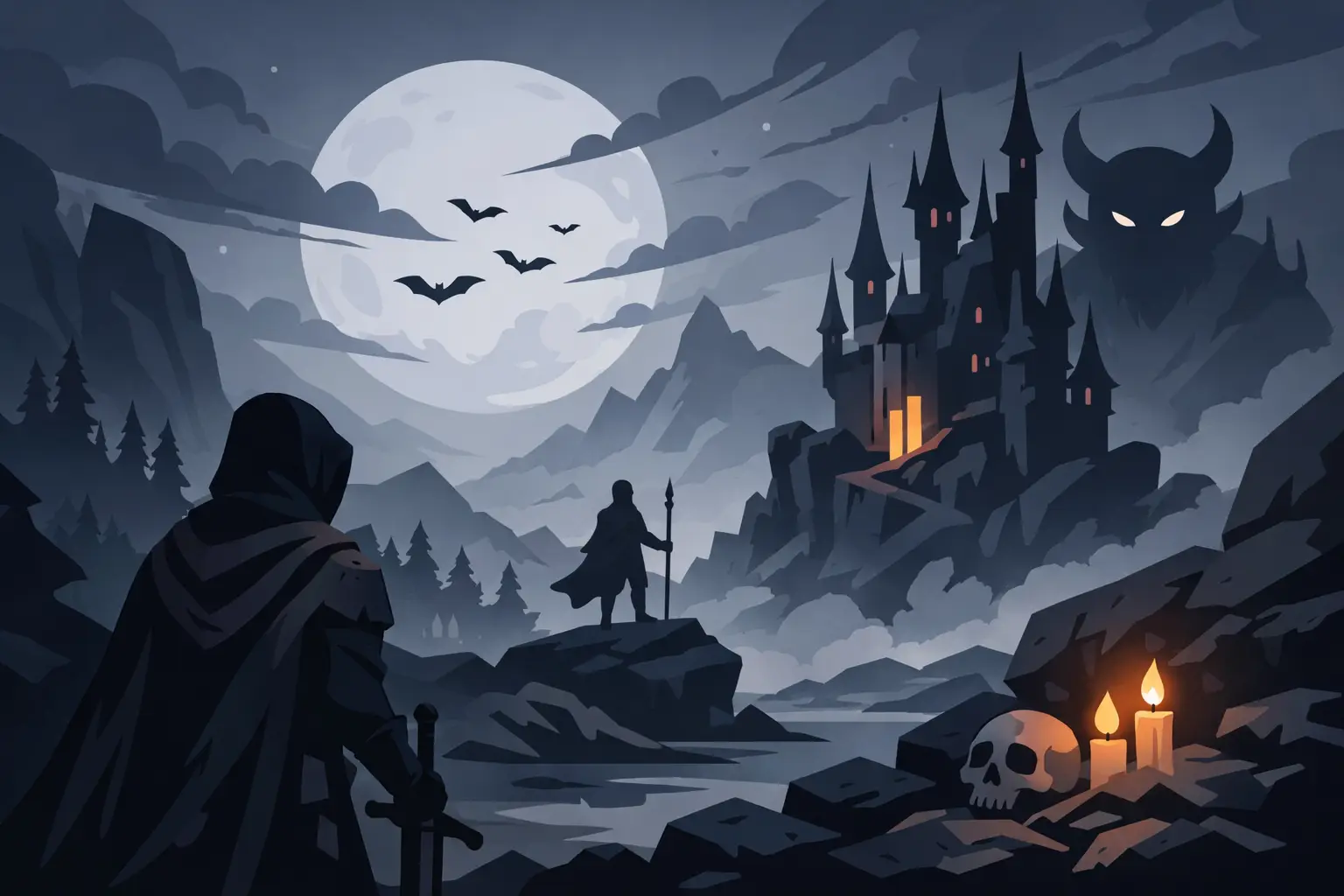
A king kneels in prayer while his realm rots behind him. A prophet speaks truth, but truth arrives dressed as ruin. A hero wins the battle and loses his soul. This is often the ground dark fantasy walks upon. If you have asked vad är mörk fantasy, the short answer is simple: it is fantasy shaped by dread, moral fracture, and a world where power always demands a cost.
But the full answer is heavier than a definition. Dark fantasy is not merely fantasy with violence, nor is it only a matter of blood, ash, and grim castles. It is a mode of storytelling where the light does not vanish, yet never reigns uncontested. Faith is tested. Justice is partial. Hope survives, if it survives at all, in wounded form.
What is dark fantasy? A clear explanation
Dark fantasy stands at the meeting point between fantasy and horror, though not every dark fantasy story leans equally toward both. Some works are epic in scale, built on kingdoms, dynasties, and wars. Others feel intimate and claustrophobic, following a single doomed figure through corruption, grief, or obsession. What binds them together is tone and consequence.
In traditional heroic fantasy, the struggle between good and evil is often clearer, even when the road is difficult. In dark fantasy, the struggle is clouded. Institutions are compromised. Noble causes become engines of cruelty. The monster may be ancient and supernatural, but it may also be a church, a crown, a family line, or a belief carried too far.
That difference matters. A dark fantasy world does not simply contain darkness. It is structured by it. The setting, the politics, the theology, and the people all bear its mark.
The core traits of dark fantasy
The first trait is moral ambiguity. Characters in dark fantasy are rarely clean embodiments of virtue. They are burdened, compromised, divided against themselves. Even when they act with honor, that honor often extracts a brutal price. A ruler may preserve order through terror. A rebel may seek freedom and still leave a trail of slaughter behind.
The second trait is atmospheric dread. Dark fantasy relies on mood as much as plot. Ruined sanctuaries, plague-shadowed cities, forests older than memory, relics that should not be touched – these are not decorative. They tell the reader that the world is wounded, and that history itself may be contaminated.
The third trait is consequence. Actions in dark fantasy tend to echo. Violence scars. Betrayal reshapes entire realms. Prophecy does not arrive as a tidy promise, but as a burden that distorts everyone who believes in it. When power changes hands, the world does not reset.
The fourth trait is a serious engagement with fear. This is where dark fantasy differs from simply being ”adult” fantasy. The fear may be supernatural, existential, spiritual, or political. Sometimes it is the fear that evil cannot be defeated. Sometimes it is the worse fear that evil can be defeated only by becoming intimate with it.
Not all grim fantasy is dark fantasy
This is where genre discussion becomes more precise. People often use dark fantasy, grimdark, gothic fantasy, and horror fantasy as if they mean the same thing. They do not.
Grimdark usually emphasizes cynicism, brutality, and the collapse of idealism. Its worlds are often pitiless, and its characters survive by compromise or cruelty. Dark fantasy can overlap with that, but it does not have to be cynical. It may still allow for grace, sacrifice, or sacred purpose, even when those things are fragile.
Gothic fantasy is often more concerned with decay, inheritance, secrecy, and haunted beauty. Horror fantasy may place fear itself at the center, pushing dread and shock further than dark fantasy usually does. Dark fantasy can borrow from both, but it remains its own current. It is less about a single aesthetic and more about what kind of world the story believes in.
So if someone asks vad är mörk fantasy, a better answer might be this: it is fantasy that treats darkness as a governing force, not a passing obstacle.
Why readers are drawn to it
Dark fantasy speaks to readers who want more than escape. Not because escapism is lesser, but because some stories offer a different kind of truth. They take the oldest questions – what gives power legitimacy, what faith survives corruption, what a soul can endure – and place them in worlds large enough to make those questions thunder.
There is also a particular emotional power in dark fantasy. Hope, when it appears, feels earned. Loyalty matters more in a treacherous world. Mercy matters more when vengeance is easy. A small act of decency can strike harder than a grand victory in a lighter tale.
This is why readers who love dense worldbuilding often find a home here. In strong dark fantasy, the lore is not ornament. Religion, law, history, war, and myth all shape the conflict. The world feels inhabited by forces older than the plot and often more merciless than any one villain.
What dark fantasy is not
It is not simply fantasy with graphic content. Violence alone does not make a story dark fantasy. Neither does profanity, sex, or a high body count. Those may appear, but they are surface elements.
It is also not the absence of hope. This is a common misunderstanding. Some of the strongest dark fantasy contains profound hope, but never cheap hope. It is hope under siege. Hope that bleeds. Hope that survives not because the world is kind, but because someone chooses not to surrender their last measure of humanity.
And it is not always medieval. Many dark fantasy works use a pseudo-medieval frame because castles, swords, dynasties, and church power naturally support the genre’s concerns. But the essence of dark fantasy lies in spiritual and moral pressure, not only in setting.
How the worldbuilding changes the genre
In lighter fantasy, worldbuilding often expands wonder. In dark fantasy, worldbuilding often deepens tension. The map itself can feel accusatory. Borders are drawn by old massacres. Thrones are founded on disputed bloodlines. Sacred texts have competing interpretations, and each interpretation may justify war.
This is where the genre becomes especially rich. A dark fantasy world is strongest when its darkness is historical rather than decorative. If a kingdom is cruel, there should be roots to that cruelty. If a faith is divided, the schism should shape daily life. If monsters roam the frontier, people should have built rituals, myths, and politics around that fact.
For readers who care about depth, this distinction is everything. Darkness without structure becomes empty style. Darkness with history becomes atmosphere, pressure, and meaning.
A great deal of modern dark fantasy succeeds because it understands this. The realm is not grim so the book can look serious. The realm is grim because the story is asking how people live under broken systems, inherited violence, and sacred claims that cannot be easily resolved. That is one reason brands like Naissusbooks resonate with readers who want fantasy to feel ceremonial, political, and morally exacting rather than merely bleak.
Common themes you will see again and again
Certain themes return because they suit the genre’s nature. Corruption is one of them, not just personal corruption but institutional corruption. A church, empire, order of knights, or royal house may begin as a promise and end as a devouring machine.
Legitimacy is another. Who has the right to rule? Blood, prophecy, conquest, divine sanction, popular will – dark fantasy rarely lets these answers stand uncontested. Every claim to authority carries a shadow.
Faith also appears often, especially faith under pressure. Not generic spirituality, but belief as law, hierarchy, burden, and consolation. Dark fantasy tends to take religion seriously, whether as solace, weapon, or battlefield.
Then there is sacrifice. In many dark fantasy stories, the central question is not whether victory is possible, but what must be surrendered to reach it. Land. Innocence. Memory. Love. The soul itself.
How to tell if a book is truly dark fantasy
Ask what the book believes about the world. If darkness is mostly visual – ravens, skulls, black armor, ruined towers – but the story still moves through familiar heroic assurances, it may be dark in style more than substance.
If, on the other hand, the story treats power as corrosive, history as haunted, morality as costly, and hope as something that must be defended inch by inch, you are likely standing in dark fantasy. The emotional aftertaste matters too. Dark fantasy often leaves the reader with awe, grief, unease, and a strange form of reverence.
That does not mean every ending must be tragic. Some of the finest endings in the genre offer hard-won restoration. But even then, the scars remain visible. Nothing true comes without inheritance.
Why the genre endures
Dark fantasy endures because it gives shape to fears that cleaner stories sometimes soften. It understands that evil is not always foreign. Sometimes it is enthroned. Sometimes it is sanctified. Sometimes it speaks in the language of duty.
Yet the genre also endures for another reason. It does not only show ruin. At its best, it asks what remains worthy inside ruin. Oath, mercy, witness, defiance, faith – these become brighter when the surrounding world grows severe.
So what is dark fantasy? It is fantasy that descends into the contested ground between terror and meaning. A realm of ash, prophecy, betrayal, and burden, where the soul is tested as harshly as the sword. If that kind of story calls to you, trust the instinct. Some readers are not looking for gentler worlds. They are looking for worlds that tell the truth through shadow.