
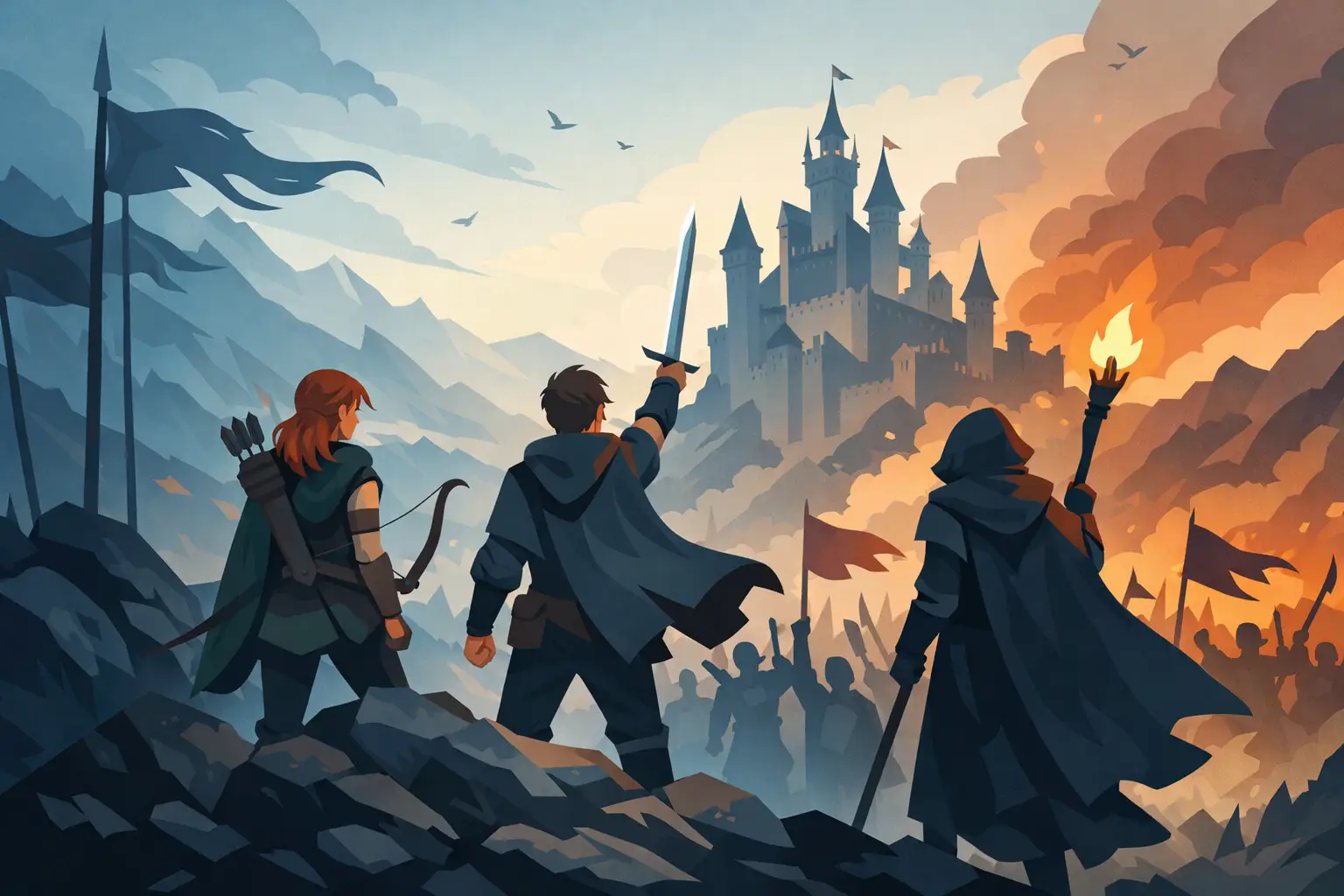
Rebellion in fantasy is rarely clean. It begins with a grievance, but it does not stay there. Before long, it becomes a contest over who may rule, whose suffering counts, and what new cruelties are permitted in the name of justice. That is why fantasy novels about rebellion hold such enduring power. They do not merely stage battles against a throne. At their best, they ask whether revolt can remain righteous once blood is in the ledger.
For readers who favor darker epic fiction, rebellion is one of the richest fault lines in the genre. It brings war, prophecy, class resentment, religious fracture, and the private corrosion of those asked to lead. Some books treat uprising as liberation. Others treat it as inheritance, curse, or political necessity. The difference matters.
Why fantasy novels about rebellion endure
A rebellion gives fantasy an immediate moral charge. The world is already broken when the story begins. Someone has seized too much power, some sacred order has rotted, or some empire has mistaken obedience for peace. The rebel force enters not as ornament, but as pressure against a system that cannot stand forever.
Yet the strongest novels refuse simple virtue. They understand that insurrection attracts idealists and opportunists alike. A peasant levy, a religious reform movement, a dispossessed heir, and a cabal of nobles can all oppose the same crown for very different reasons. That tension gives the story weight. A reader is not only asking who will win. The real question is what kind of world victory will permit.
This is where dark fantasy often surpasses lighter heroic modes. It recognizes that rebellion is made of hunger, fear, faith, and vengeance as much as courage. It asks what happens after the gates fall.
12 fantasy novels about rebellion worth your time
Mistborn by Brandon Sanderson
At first glance, Mistborn offers one of fantasy’s clearest revolutionary premises: a brutal immortal ruler, a crushed underclass, and a conspiracy aimed at toppling the empire. What gives the book its staying power is how carefully it balances hope with manipulation. The rebellion needs symbols as much as soldiers, and the line between genuine faith and engineered myth begins to blur.
It is an accessible entry point if you want rebellion framed through heist structure and hard magic. It is less morally savage than grimmer works, but it understands that overthrowing a regime creates new burdens no plan can fully anticipate.
The Traitor Baru Cormorant by Seth Dickinson
Some rebellions begin from outside the system. Baru’s begins inside it. Rather than raising a banner in open war, she attempts something colder and more dangerous: infiltrating the imperial machine that colonized her homeland and turning its logic against itself.
This is one of the sharpest fantasy novels about rebellion if you care about empire, assimilation, and the cost of strategic compromise. It is not a tale of glorious charges. It is a study in corrosion. Every victory leaves a mark.
The Grace of Kings by Ken Liu
Here rebellion unfolds on an imperial scale, with rival leaders, shifting loyalties, and the old question of whether a revolution belongs to the people or the men charismatic enough to command them. Liu gives the conflict a legendary sweep, but he never loses sight of material realities such as taxation, engineering, legitimacy, and public myth.
What makes it compelling is that no single rebel vision remains pure. The coalition that overthrows power cannot remain united once power becomes attainable.
Red Rising by Pierce Brown
Though often shelved closer to science fantasy, it belongs in this conversation because its rebellion is built on caste oppression, spectacle, and calculated rage. Darrow’s revolt is personal at first, then systemic, then nearly mythic in scale.
The prose moves fast, and the political architecture is sometimes less intricate than in more literary works, but the emotional engine is strong. If you want rebellion sharpened into revenge and then expanded into a wider social war, it delivers.
The Shadow Campaigns by Django Wexler
This series is ideal for readers who want military fantasy where rebellion is inseparable from statecraft. Revolt does not arrive as a single noble cause. It erupts in competing forms: popular unrest, coups, ideological conflict, and colonial tension.
Wexler is especially good at showing that the army sent to suppress rebellion can become politically unstable itself. That uncertainty gives the books a historical density many fantasy wars lack.
The Unbroken by C.L. Clark
The Unbroken takes the language of rebellion and places it against the machinery of colonial rule. A soldier raised by the empire is sent back to the people the empire conquered, where loyalty becomes not just divided but almost impossible to define.
This is a novel of fractures rather than easy awakenings. It treats resistance as intimate, compromised, and often tragic. Readers who want rebellion tied to identity, occupation, and political desire will find real depth here.
The Priory of the Orange Tree by Samantha Shannon
This novel is larger and more diffuse than a pure rebellion narrative, but rebellion runs through its bloodstream in the form of resistance to inherited power, hidden truths, and sacred political arrangements that no longer deserve obedience. It is interested in queenship, dynastic expectation, and religious myth as forces that bind whole realms.
If you prefer your rebellions braided into a broader epic tapestry, this is a strong choice. It is less focused on insurgency itself than on the conditions that make resistance inevitable.
A Time of Dread by John Gwynne
Gwynne writes conflict with force, and rebellion in his work often carries the texture of old loyalties breaking under spiritual and martial pressure. This novel, and the larger sequence around it, leans into prophecy, war-hosts, and the sense that resistance can be both sacred duty and human catastrophe.
It suits readers who want a more traditional epic frame without losing the darker implication that righteous causes still breed ruin.
The Poppy War by R.F. Kuang
This is not a rebellion novel in the narrowest sense, but it belongs on this list because it tracks how war, national trauma, and ideology can transform the oppressed into instruments of overwhelming violence. When resistance hardens into doctrine, moral boundaries can disappear.
Kuang refuses comfort. If you want fantasy that forces the question of whether vengeance can ever remain distinct from atrocity, few books cut deeper.
The Final Strife by Saara El-Arifi
Built around a rigid social hierarchy, this novel uses rebellion as both political movement and existential necessity. Power is distributed through blood, rank, and ritual, and resistance emerges from those denied any honorable place within that order.
It is especially effective for readers drawn to social revolution rather than dynastic succession. The anger here feels structural, not incidental.
The Black Company by Glen Cook
Cook’s classic offers a different angle: rebellion seen from the perspective of soldiers trapped in the machinery of greater powers. Allegiance is unstable. Justice is murky. Prophecy and force pull the company through conflicts where no side keeps clean hands.
If you want rebellion stripped of romantic gloss, this is essential reading. It does not ask you to cheer blindly. It asks you to endure ambiguity.
The Pariah by Anthony Ryan
Though more concerned with conquest, legitimacy, and violent ascent than outright mass uprising, The Pariah earns its place through the way it treats social disorder and contested authority. Rebellion here is not only a movement in the streets. It is also the quiet collapse of trust in institutions, faith, and noble command.
That distinction matters. Some of the strongest rebellion fiction is not about banners raised at once, but about a realm becoming ungovernable.
What separates a great rebellion story from a merely exciting one
Scale helps, but scale is not enough. A rebellion story becomes memorable when the old order has genuine texture and the rebel cause has genuine cost. If the tyrant is evil in a flat, theatrical way, revolt feels preordained. If the rebels are pure-hearted instruments of justice, victory feels cheap.
The finest fantasy understands that every regime justifies itself in sacred or historical language. Kings invoke blood. Priests invoke divine mandate. Empires invoke civilization. A serious rebellion must answer those claims, not just militarily, but morally. It must persuade people to imagine legitimacy differently.
That is why faith and rebellion so often travel together in dark fantasy. Once a people cease to believe a throne is holy, the throne becomes mortal.
Where to start, depending on what you want
If you want a classic uprising against an immortal despot, begin with Mistborn. If you want something colder and more devastating, choose The Traitor Baru Cormorant. If military campaigns and political fragmentation appeal to you, The Shadow Campaigns or The Grace of Kings will serve you well.
If your taste runs toward occupation, identity, and the wounds of empire, start with The Unbroken. If you want rebellion with the taste of ash in its mouth, read The Poppy War or The Black Company.
Readers who come to fantasy for theology, burdened crowns, and the price of legitimacy will often find themselves returning to rebellion narratives because they reveal the soul of a world under stress. Every kingdom praises order while it stands. Rebellion is the hour when that order must finally answer for itself.
Some novels let revolt end in triumph. The more honest ones know better. They know a rebellion can save a realm and still leave it haunted. That is precisely why these stories endure. They do not promise purity. They promise consequence – and for serious fantasy readers, that is the greater reward.